
Colonial-Era Classism? Thousands Displaced as Lagos Demolishes Homes in Makoko
Thousands of residents in Makoko, a historic waterfront settlement in Lagos, were displaced after demolition operations carried out by the Lagos State Government between December and early February. State authorities said the exercise was to enforce safety setbacks from high-tension electricity lines, while community leaders and civil society groups disputed the scope of the demolitions and raised concerns over compensation.
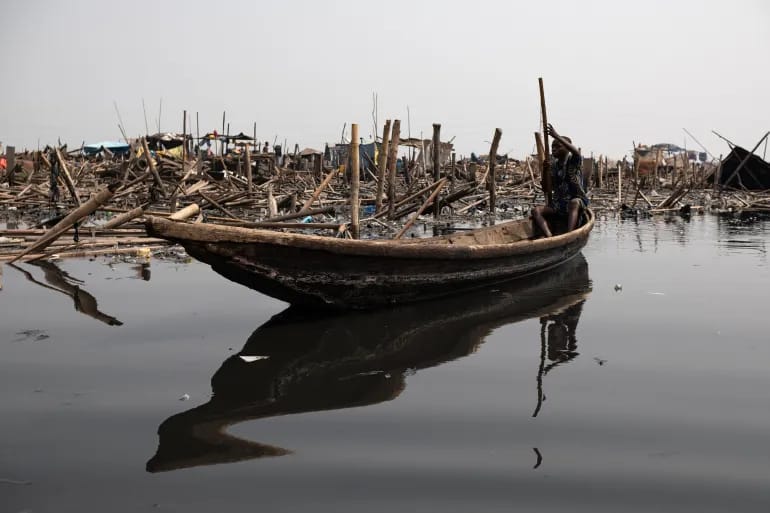
Thousands of residents of Makoko, a waterfront community in Nigeria’s commercial capital, have been displaced following demolition operations conducted by the Lagos State Government.
According to Al Jazeera, the demolitions began in late December and continued into early February before the Lagos State House of Assembly ordered a halt to the exercise after protests and public concern.
The Lagos State Government said the demolitions were carried out to enforce a 100-metre safety setback from high-tension electricity lines in the area. Lagos State Governor Babajide Sanwo-Olu stated that the government was “clearing areas to ensure they do not encroach on the Third Mainland Bridge and to keep residents away from high-tension lines,” according to Al Jazeera.
However, community representatives and civil society organisations working in Makoko said the demolitions extended beyond the stated 100-metre limit. Advocacy groups alleged that structures located between 250 and 500 metres from the power lines were also destroyed.
Al Jazeera further reported that thousands were rendered homeless during the operation and that more than 12 people, including two infants, died during the period of displacement, according to local advocates.
Makoko, often referred to as the “Venice of Africa”, is a historic fishing settlement built largely on stilts over the Lagos Lagoon. It is located near the Third Mainland Bridge, which connects Lagos Island to the mainland. The community is home to an estimated 200,000 residents, many of whom depend on fishing and fish processing for their livelihoods.
Residents reported that police were present during the demolitions, and tear gas was fired when community members protested.
Civil society groups have raised humanitarian concerns. Victoria Ibezim-Ohaeri, Executive Director of Spaces for Change, told Al Jazeera that the demolitions disrupted schooling and increased vulnerability among women, elderly persons and people with disabilities.
Under Nigeria’s constitution, property acquisition by the government requires due process and compensation. Lagos State Commissioner for Information Gbenga Omotoso said compensation would be determined after affected residents are identified and documented.
Activists also questioned whether safety concerns were the sole reason for the demolitions. According to Al Jazeera, local reports last year indicated that the government had entered into agreements for development projects in the Makoko area, including land reclamation activities.
Historical precedents were cited by advocates. About 300,000 residents were evicted from Maroko in 1990, and thousands more were displaced from Otodo-Gbame in 2017, both waterfront communities in Lagos.
Following negotiations, Al Jazeera reported that the Lagos State House of Assembly reached a compromise with community representatives. Residents agreed not to rebuild on the demolished areas, while a committee would determine compensation and oversee a proposed regeneration project.
The situation in Makoko continues to generate debate about urban development, housing policy and the protection of vulnerable communities in Lagos.





















.jpeg)





































