
Pauline Hanson Suspended from Senate After Wearing Burqa in Protest
One Nation Leader Pauline Hanson sparked outrage in the Australian Senate after entering the chamber in a black burqa to protest against Islamic face coverings. Her stunt, tied to her push for a nationwide ban, led to more than 1.5 hours of suspended parliamentary proceedings. Hanson defended her act as a national security and rights issue, but she was widely condemned as Islamophobic.
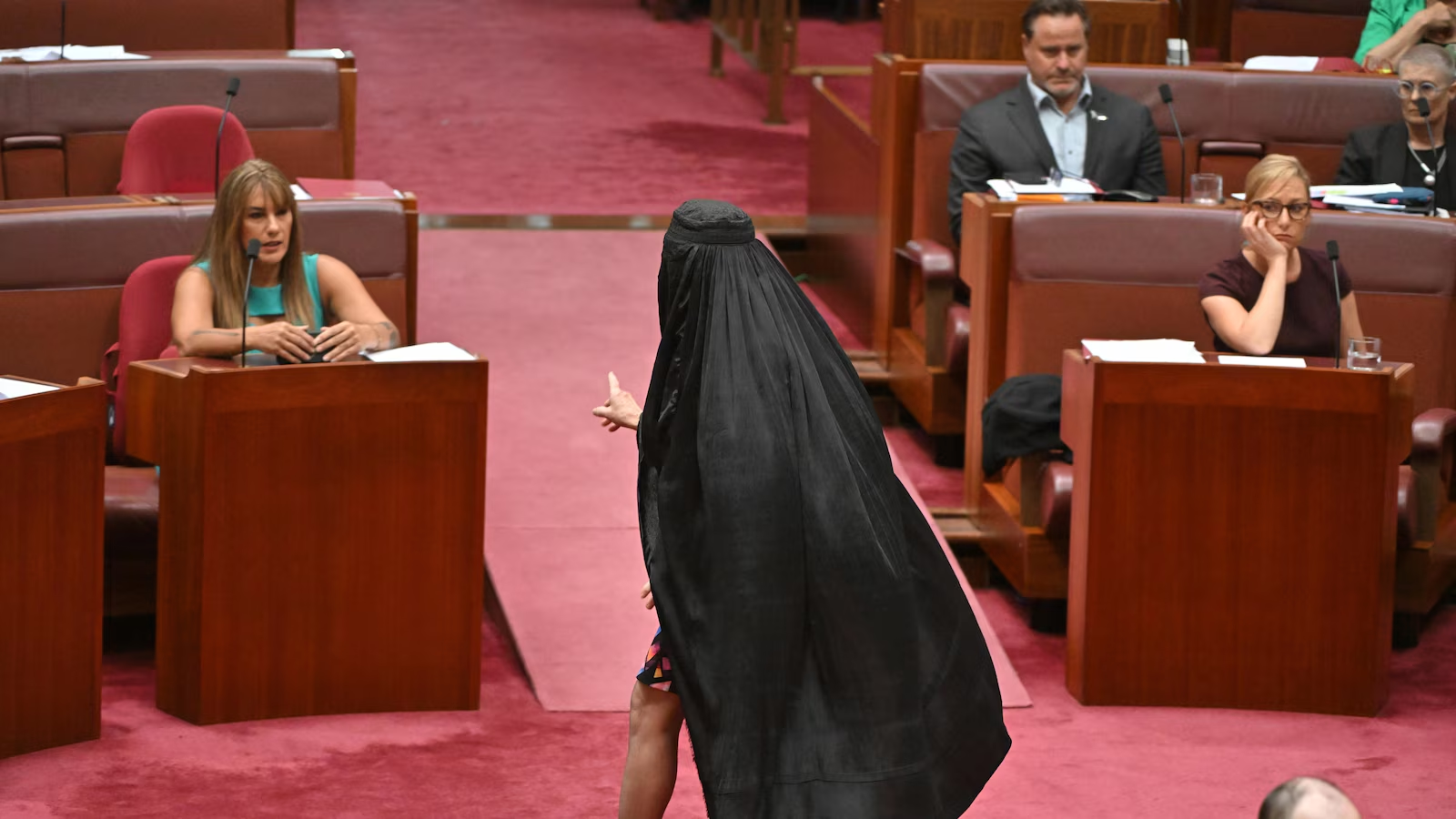
One Nation Leader Pauline Hanson wore a burqa into the Senate on Monday, prompting a rare suspension of the chamber and sharply critical rebukes from colleagues across the political spectrum after she refused to remove the garment when asked by the president of the Senate.
A burqa is a full-body outer garment that covers a person from head to toe, including their face. It is most often associated with conservative Islamic practices and typically has a mesh or cloth screen over the eyes so the wearer can see.
According to ABC News and Reuters, the disruption unfolded in the afternoon sitting when Hanson, who had been denied leave to introduce a private senator’s bill that would ban full-face coverings in public places, entered the chamber wearing a black burqa. Senators immediately reacted with anger, and Senate President Sue Lines warned Hanson that the garment could not be worn as a “prop” in the chamber. When Hanson refused to leave, proceedings were suspended for more than an hour and a half. Foreign Minister Penny Wong moved to sanction Hanson and ban her from the chamber for the rest of the day; the motion was carried.
Hanson defended her action in brief media remarks outside Parliament House, telling 10 News the stunt was intended to draw attention to what she described as a national security issue and concerns about women being forced to wear this garb. She added that the issue was also one of women’s rights. According to the ABC News live blog, she said, "It is a national security issue, it is about women’s rights, and a lot of women are forced to wear this garb."
The stunt revived painful memories of a similar episode in 2017 when Hanson wore a burqa in the House of Representatives, an act that drew sustained condemnation at the time. This week’s repetition was met with swift and broad criticism. Greens senator Mehreen Faruqi labelled the act “racist,” while independent senator Fatima Payman called it “abhorrent” and “disrespectful” to Muslim Australians. Multiculturalism Minister Anne Aly said the stunt was “unacceptable” and risked dividing communities, as stated by The Guardian.
ABC News reports that Senate leaders from both government and opposition accused Hanson of bringing the chamber into disrepute. “Whatever our own beliefs may be, the sort of disrespect you are engaging in now is not worthy of a member of the Australian Senate,” Penny Wong said on the floor before moving the sanction.
Hanson’s proposed bill to ban burqas and other face coverings in public had been refused procedural leave earlier in the day, with senators describing the measure as unnecessary and inflammatory. The One Nation leader has long campaigned on curbing what she calls extreme cultural practices and has pointed to laws in some countries that restrict face coverings. Critics say her approach scapegoats Muslim women and fuels Islamophobia rather than addressing genuine security issues.
The episode has again put questions of parliamentary conduct, religious freedom and national security under the spotlight. Muslim community leaders described feeling insulted and unsafe after the stunt, while Hanson’s supporters said she was exercising political speech on an issue she believes affects public safety.
ABC News reported that proceedings eventually resumed late in the afternoon after Hanson was escorted from the chamber. Senate President Sue Lines said the rules of the chamber must be respected and emphasised that the parliament is a place for “serious debate,” not theatrical protest.





















.jpeg)





































