
Religious‑Freedom Crisis Erupts As Vance Pressures Wife To Convert
Vice President J.D. Vance ignited a heated debate on religious freedom this week after publicly expressing his hope that his Indian American, Hindu-raised wife, Usha Vance, may one day convert to Christianity. His comments, according to the Washington Post, made at a Turning Point USA event at the University of Mississippi provoked sharp criticism along religious, cultural, and political fault lines.
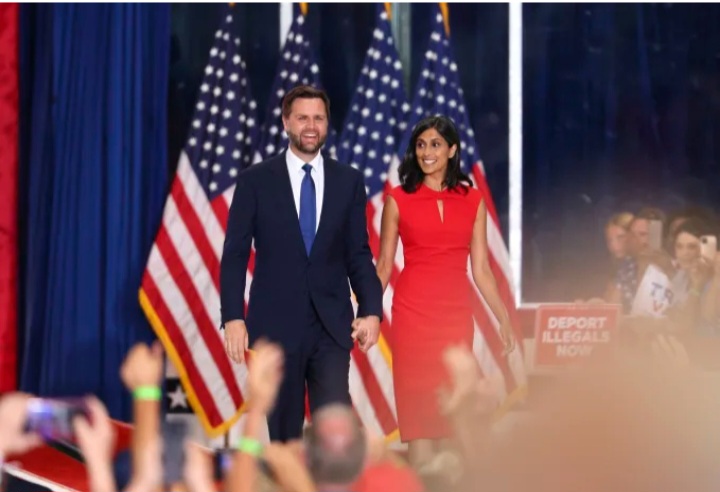
Information from Wikipedia reveal that Vance and his wife are in a high-profile interfaith marriage: they met at Yale Law School, married in 2014 in a ceremony that included both Hindu and Christian elements, and now raise their three children in the Christian faith. His own faith journey saw him convert to Catholicism in 2019.
At the event, Vance told the audience, “Do I hope that eventually she is somehow moved by what I was moved by in church? Yeah, honestly, I do wish that because I believe in the Christian Gospel,” reports the Washington Post. He added, however, that if she doesn’t convert, it’s not a problem: “God says everybody has free will.”
Online reaction was swift. Critics condemned the remarks as dismissive of Usha’s Hindu identity and emblematic of Christian supremacy, with many calling it an expression of systemic religious intolerance. The Hindu American Foundation, for instance, warned that Vance’s words echo a long history of Christian proselytization aimed at Hindus. Some analysts and commentators also argued that his statement has been politicized that it plays into a broader narrative in America where Christianity is treated as not just a personal faith but the default or superior religion.
Vance defended himself in a post on X, calling some of the backlash “anti-Christian bigotry.” He emphasized that his wish is personal, not coercive: “She is not a Christian but I hope she may one day see things as I do. Regardless, I’ll continue to love and support her because she’s my wife.” Sourced from Yahoo.
Still, the public debate underscores a larger tension: how deeply religion remains tied to identity and politics in America. Critics argue Vance’s remarks reveal an underlying intolerance, a belief, perhaps unconscious but powerful, that Christianity should be the acceptable norm, and that others’ faiths are secondary. As the controversy unfolds, it raises difficult questions about the meaning of religious freedom in a pluralistic democracy.





















.jpeg)





































