
The Mercury Fever
As a reality-warping heat wave liquefies the American landscape, scientist Neil Murray and his partner Clara navigate a world where birds swim through golden-haze air and suburban lawns shatter like glass. Despite the President’s narcissistic dismissal of the crisis as a nasty hoax, the physical world collapses, fusing car engines and detaching shadows from their owners. Escaping the crumbling suburbs on a climate-ready camel named Silas, Neil and Clara reach the coast only to find the Atlantic Ocean has undergone an impossible phase change, transforming into a solid, unyielding sheet of sapphire. This undeniable environmental shift finally forces a humiliating national address from the President, who acknowledges the catastrophe and appoints Neil to lead a desperate scientific task force from a government bunker to save what remains of the planet.
The heat had fused the world, but in the shimmering crucible of their bedroom in suburban Virginia, it had forged Neil Murray and Clara into something elemental. The air, thick as syrup at 40°C, hummed with their skin-on-skin friction. Inside, shielded by heavy curtains and a dying AC unit, they were a universe unto themselves.
Clara received him with an aching, open desperation, her body slick and yielding in the sweltering dark. As Neil moved over her, he felt a profound sense of dissolution, as if the boundaries of his own skin were melting away. He got lost in the rhythmic heat of her, the friction of their bodies generating a fever that rivaled the sun outside. Every movement was a struggle against the heavy atmosphere, a slow-motion dance of salt and fire. When the climax finally hit, it was a shared, jagged explosion, a rhythmic, agonizing perfection that made the crumbling world outside vanish. In the quiet after, Clara lay draped across him, her head rising and falling with the frantic drum of his heart. "If we melt," she whispered against his damp skin, "let's melt together."
The world outside, however, was already liquefying. The thermometer on their porch didn't just break; it wept. The red liquid bubbled, hissed, and stained the wood like a lingering wound. As the temperature climbed past 45°C, the physical laws of America began to fray. At 48°C, shadows uncoupled from their owners. You could walk across the asphalt and leave your shadow standing three feet behind you, pinned by the sheer weight of the sun. At 50°C, the birds stopped flying; they swam through the air in a slow, rhythmic crawl through golden haze, gasping for oxygen that felt like molten lead. By noon, the lawns of the D.C. suburbs turned to glass; if you stepped on a blade of grass, it shattered with a musical chime.
Then came the Thermal Echoes, ghosts of people from ten minutes prior, trapped like flies in amber, moving independently and searching for the warmth of a living heart.
Inside the White House, the air conditioning was a roar of defiance. The President stood behind a sagging podium, leaning into the microphone with a familiar, predatory smirk. "Look, folks," he started, waving a dismissive hand. "We’ve had heat before. It’s called July. It’s a beautiful July, maybe the warmest ever. But this 'Mercury Fever'? It’s a hoax. A very expensive, very nasty hoax. And you have people like Neil Murray—I call him 'Nasty Neil'—he’s a loser, frankly. He’s a total disaster. He wants to tell you the birds are swimming. I saw a bird today, it looked great. It was a very high-energy bird. Neil Murray wants to shut down your cars, shut down your life. He’s a fake scientist, okay? We have the best air. We’re going to have the highest numbers anyone has ever seen, and frankly, the rest of the world is very jealous of our heat."
The President’s words met a harsh reality as the mercury hit 58°C. American car culture died instantly. Engines simply seized as oil reached its flashpoint. Internal rubber seals melted, fusing pistons to cylinders and tyres to the pavement. The internal combustion engine had become a static monument to a lost age. But Neil Murray had long been prepared. Years of being called a "doomsday nut" had led him to keep a dromedary camel named Silas in a fortified, climate-controlled stable in his backyard.
"The cars are dead, Clara," Neil said, his voice husky as he led the beast out. The camel’s padded feet were the only thing that could navigate the shattered glass of their lawn without flinching. They mounted Silas, their skin covered in reflective cooling suits, and began the long trek toward the Atlantic. They passed the ruins of a highway where thousands of cars sat fused to the road, their drivers having abandoned them for the Thermal Echoes that now populated the breakdown lanes.
As they reached the dunes of the Chesapeake, they encountered a mob of skeptics. They were holding "SUNLIGHT IS STRENGTH" banners, their skin smoking in the 62°C haze. A group of sweat-drenched journalists spotted the man on the camel. "Dr Murray!" a reporter screamed, shoving a softening microphone toward him. "The President says you're a 'nasty loser'! What do you say to the people who believe the heat is a sign of American greatness?"
Neil looked down from the camel. "The President is playing a tune while the violin melts in his hands," he said firmly. "Science doesn't care if you believe in it or not. Science will prevail."
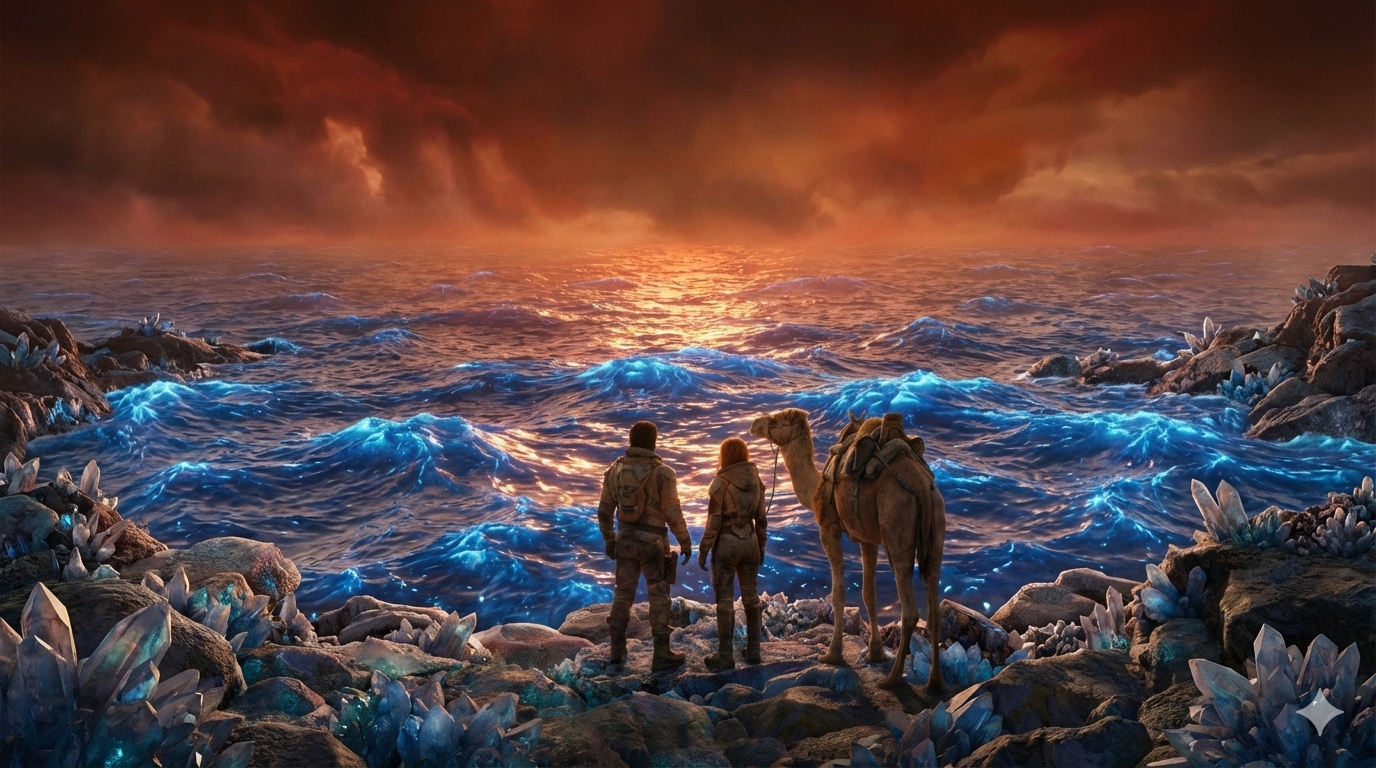
They pushed past the crowd to the shoreline. But the Atlantic wasn't a shimmering blue. It was a vast, unbroken sheet of solid sapphire. The waves had frozen mid-crest into crystalline structures, an impossible, unyielding blue desert that stretched to a metallic-silver horizon. "It’s over," Clara breathed, touching the cold, hard surface of the sea. "The ocean has changed phase."
They turned Silas around, the camel’s steady gait the only thing moving in a world of glass. They trekked back through the shimmering mirages until they reached the hidden entrance of a deep-earth government bunker. Days later, the world’s remaining screens flickered to life. The President sat in a bunker of his own, his golden hair slightly askew.
"My fellow Americans," he said, and for the first time, he didn't smirk. "A lot of people are saying I was right, but it turns out the heat is actually very, very strong. Maybe too strong. Even for me. It’s a total disaster. And I’ve made a very big decision—that Neil Murray, who is actually a very smart guy, a brilliant guy, is going to lead a team. I told Neil, 'Neil, you’ve got to fix it. Only you can do it.' We're going to make the weather great again."
In the makeshift lab, Neil leaned against the sapphire-cool walls of the bunker, Clara’s hand in his. He looked at the monitors, ready to start the impossible work of cooling a planet that had finally run out of lies.





















.jpeg)





































