
US Long-Haul Truckers Struggle as Diesel Prices Surge to $5
American long-haul truckers are facing renewed financial strain as diesel prices climb past $5 per gallon, compounding pressures from years of economic instability, according to reports from the BBC News and other outlets.
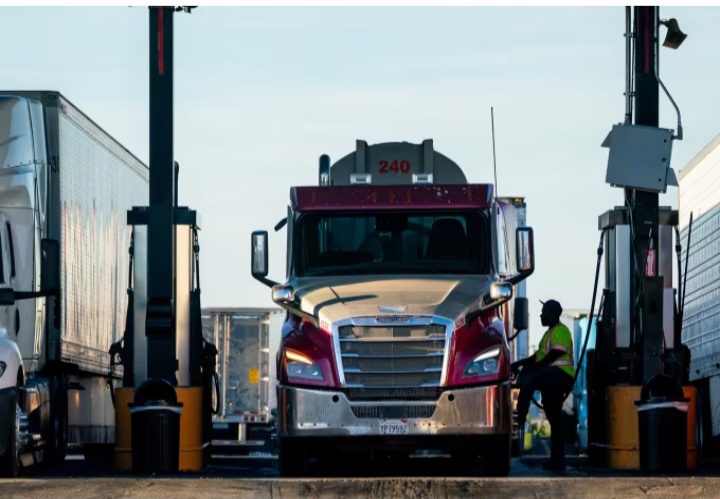
The trucking industry, still recovering from the aftershocks of the Great Recession and more recent freight downturns, is now grappling with soaring fuel costs, its single largest operating expense. Analysts say the sector has endured a prolonged “freight recession,” marked by falling rates and oversupply following a pandemic-era boom, leaving many operators financially exposed.
Recent data shows diesel prices rising sharply to over $5 per gallon nationwide, a surge driven largely by global supply disruptions linked to geopolitical tensions. This spike represents a dramatic increase from roughly $3.60 a year earlier, squeezing already thin margins for independent drivers.
For many truckers, the impact is immediate and severe. Unlike large logistics firms, independent operators often cannot pass rising fuel costs on to customers. “Cash flow is becoming our biggest issue,” one US trucker told reporters, describing how higher diesel prices are wiping out profits almost overnight. Another driver added: “We were already on the breaking point… this is like the nail in the coffin.”
Industry experts warn that smaller carriers are the hardest hit because they operate on fixed per-load rates and must pay upfront for fuel while waiting weeks, or even months, for payment. Larger firms, by contrast, can use fuel surcharges and hedging strategies to cushion the blow.
The situation echoes earlier economic shocks. During the Great Recession, many truckers were forced out of business as freight demand collapsed and costs surged. Today, a similar pattern is emerging, with rising fuel prices threatening to push struggling operators out of the market once again.
Beyond the trucking sector, economists caution that the ripple effects could be widespread. Diesel powers the movement of goods across the United States, meaning higher transport costs are likely to feed into rising prices for food, retail goods and construction materials.
As one industry manager put it, “It’s just impossible to keep up with this kind of fuel price,” warning that smaller, family-run trucking businesses may not survive if costs remain elevated.





















.jpeg)





































